
The implementation of culturally diverse literature in classrooms occurs when teachers make it happen.”
Culturally diverse literature, The Reading Teacher, Boyd, Causey & Galda
Week Six: The Parker Inheritance: A mysterious middle grades text
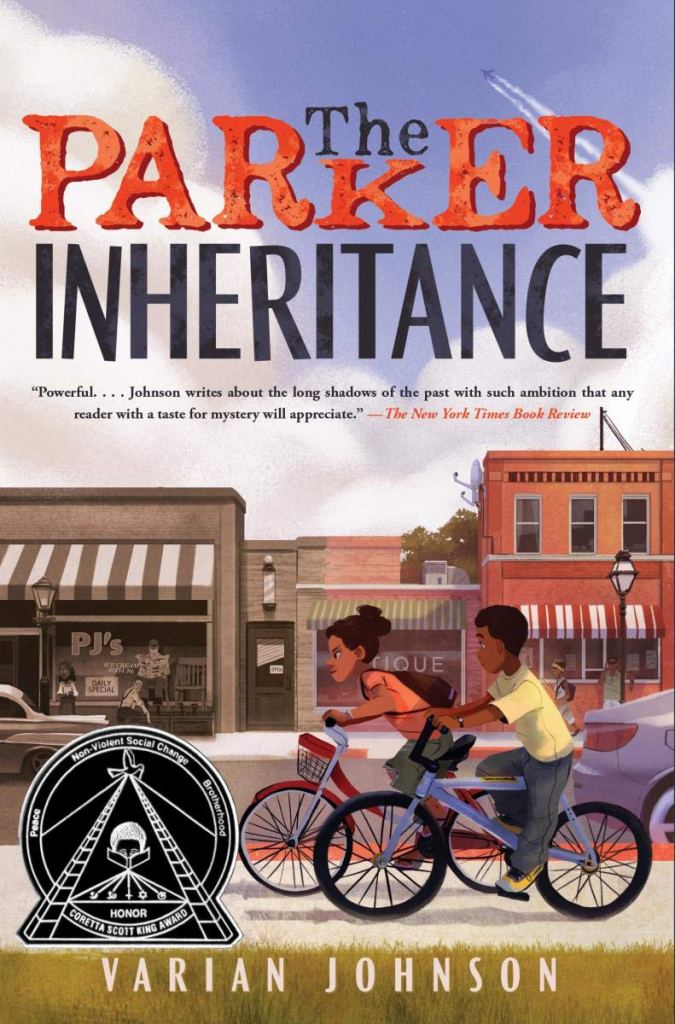
Have you ever heard the phrase “curiosity killed the cat?” I feel as though this phrase fits Abigail Caldwell and her granddaughter, Candice, really well. As this story beings, we are given an inkling that leaves us wanting to know more about that night in Lambert and even more about the reasons why Abigail did what she did. Once twelve year old Candice Caldwell discovers an old letter in her grandmothers attic- there was no going back. Her curiosity about this secretive story could have killed the cat! This is a powerful story that teaches historical information about segregation in the South as well as life lessons including relationships and determination to never give up.
I think that Varian Johnson wrote this book in such a clever way that so many children will be able to relate to the characters and events. In this book, Candice Caldwell’s mom and dad are getting a divorce- and she has a new (but temporary) home. Some students in our classes will be able to relate to this because their own parents are going through a divorce. One of the main characters, Brandon, struggles with making friends and getting bullied by kids at school. Unfortunately, we will also have students in our class like Brandon that will be able to relate to this. We may even have students in our class that are people of color who know of members of their family that were alive and affected by the Jim Crow Laws in the South. They too, will be able to relate to this text. With most of the main characters in this book being people of color, our students that are people of color will see themselves represented as main characters in the book. Lastly, we could have students in our class that are really into historical events/ historical fiction. This book will appeal to them also because of the history of segregation and intense racism that existed in the South in the 1950’s and 1960’s. There are many reasons that this book should be on our classroom bookshelves!
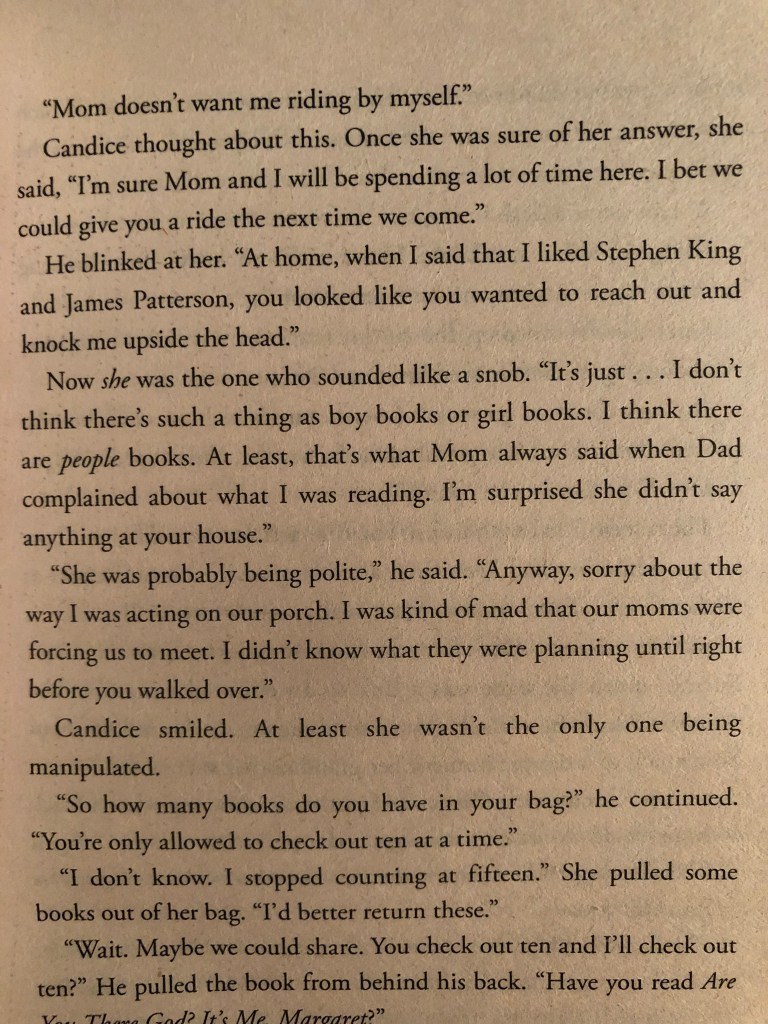
This book offers many opportunities to teach students about social justice issues that are prevalent in today’s society. These opportunities are also very subtle. While reading, I noticed that Johnson used the characters to show opposing opinions/ viewpoints amongst characters. For example, on page 102, Millie is talking about “praying for Quincy” and “hoping that his grandparents will straighten him out.” This offers an opportunity for students to subtly learn about the harsh opinions of others. I love how Candice challenges and questions those biased opinions throughout the book. She is so bold and often asks herself / others why it matters what kinds of books you read, why it matters who can/ can’t play on a sports team and also who you can and can’t be attracted to. Having a bold character such as she provides such a realistic role model for how we want our students to think about and question society. We want our students to be inclusive and understanding- and Candice Caldwell’s character is a perfect example. One of the largest opposing opinions prevalent throughout this book would be sexuality. In today’s society there are still many people who struggle with accepting the sexuality of others- especially if they are different then yours. In this book, Johnson teaches his readers about this social injustice in a way that kids are able to grapple with. He does this through his main character Candice- as she questions her friend Brandon and her own father. In this book, Candice parents recently go through a divorce- and Candice questions the root of the divorce. Towards the conclusion of the book- she discovers that her own father is gay. She also struggles watching Brandon get bullied and tormented by other boys who presume that he is also gay. I say all this to address that Johnson teaches readers that we are all people- no matter our sexuality- we are all people and we all matter. One of my favorite lines from the book was “It’s just… I don’t think there’s such a thing as boy books or girl books. I think there are people books. At least, that’s what Mom always said when Dad complained about what I was reading.” Little did I know, this was a huge foreshadow for later on in the book when we discover that her dad is actually gay.
Critically Thinking
Discuss the setting. Was the setting essential to the plot of the book? Explain why or why not. Does it add depth to the book? The setting was absolutely critical to this book! First of all, this book is placed in the Southern United States- a predominantly white and conservative area. This particular book is set in a town of Lambert, South Carolina. Which according to the text, was very segregated back in the day due to the large white population. With the plot being centered around Abigail Caldwell’s career altering decision to tear up the tennis courts, which is connected to the historical events of Jim Crow Laws- the setting is undoubtedly essential to this plot! With the plot of this book relating to some historical background, depth is added to the book. Like H.W. Bouwman’s A Crack in The Sea, we find ourselves bouncing around from modern day to another time- which in this case is the time of the Jim Crow Laws. Adding another time period is a great way to add depth to the book and keeps student’s on their toes as they have to navigate a text. Something else that I noticed that adds depth to this book is the difference in the colors of the pages. At the very beginning, the introduction is written with white font on black pages. Then, in the modern day, the pages are just like any other paperback book. However, when the setting jumps back in time to the 1950’s-60’s, the pages are a darker, almost grey color. This was really helpful as a reader to help me keep track of the time period.
What did you learn about the time period in which the book was set? Do you think the time period was described accurately? How do you know? From The Parker Inheritance, students can learn about Jim Crow Laws which were laws enforced by state and local governments to enforce the implementation of segregation of black and whites. This included segregation of many public places including schools, restaurants, buses and city parks. This is why there was such an uproar when Abigail Caldwell torn up the tennis courts in the park. Students can also learn about the history of segregation in the South- a time when blacks and whites had to use separate facilities. Because of the history included in the book, Candice wondered if children were beaten and hosed in parks back then like adults were (this was so sad to me when I read this- children should not even have to have thoughts like this!) From this book, our students can take away how serious and scary these times were for the black community.
Is the author/illustrator a cultural or #OwnVoices insider (e.g., Do they self-identify as a member of the community portrayed in the book?)? Has the book been endorsed by a reputable organization and/or insider with expertise? Varian Johnson is an #OwnVoice insider because he too, like his characters, is a black person. He does identify as a member of this community- and in the video above- describes himself as a native from Florence, South Carolina- a vibrant Black community. This book has received the 2019 Coretta Scott King Honor Award- recognizing it for the empowerment and representation of Black people throughout the book. With that being said, The Parker Inheritance is a reputable book for young adults to read.
The Common Core Curriculum & Us
As teachers, it is our job and responsibility to teach from the Common Core State Standards. It is also our job to make learning these standards purposeful for our students. I think that as teachers, we (at least I know I do,) worry about finding a standard to align with every single lesson I teach and book that I read with my students. The reading teacher coming out in me wants to advocate that we can read a book to our students just for fun- to get them engaged and excited about literature. However, there are other ways to get our students engaged in reading within our classrooms. Lisa M. Ciecierski sheds light on some important ideas about the relationship between the common core and connecting texts. Connecting texts are texts that can be used in a text set or a unit of study that share these four relationships: companion texts, corresponding texts, contradictory texts, and cluster texts. The Common Core State Standard says that students must be able to “analyze how two or more texts address similar themes or topics in order to build knowledge or to compare the approaches authors take.” So this tells us that we have to teach connected texts- but not HOW we have to teach them. Here is where our creativity as teachers can come into work! Several things to consider are they way we want the texts to connect- are they thematically related, topically related, etc. Then, we must think about the order of which we are going to use the texts in the classroom so that they make the most sense to the students- and that the students will be able to clearly identify the ways in which those texts are connected. Lastly, like all learning we need to make sure that our planning for intertextuality is purposeful and well planned for. I thought this quote; “Students have been conditioned to learn in an isolated manner, which encourages isolated thinking” was really powerful and changes my thoughts about using single, isolated texts. As teachers, we do not want our students thinking in an isolated manner- we need to break the molds of this conditioned practice and get our students thinking about connecting texts in many ways to provoke wide spread, non-isolated thoughts as they grapple with literature.
Also, as teachers we need to challenge the Common Core and look into ways that we can expand our classroom libraries to make them more culturally diverse- so we can teach diverse content, as well as appeal to all readers in our classrooms. According to the Cooperative Children’s Book Center (CCBC,) the number of books that are written representing minorities/ people of color does not correlate with the actual population. Bottom line- we want to ensure that students in our classrooms are able to access books with people that look like them and that they can relate to. We want the books in our classrooms to support a variety of people, cultures, backgrounds and identities. When deciding which books to include, look for books that have been given awards- specifically those that award diverse texts such as Coretta Scott King and Pura Belpre. The most important take away from this is that as teachers- we need to expand beyond the suggestions of diverse text from the Common Core Appendix B, and use our resources to find more authentic and representative texts for children. We live in a time where many authors are creating rich, diverse texts for our students to read! Let’s place these on our shelves.
You may also enjoy:
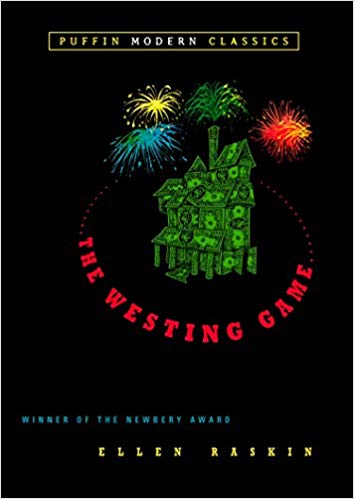
As suggested by The Classroom Bookshelf, the following texts are great to pair with The Parker Inheritance. Varian Johnson states in one of his interviews about the book that his book was inspired by The Westing Game. Ghost Boys and Holes are both award winning novels for middle grades students. These books will help you build a more diverse classroom library.


References:
- Ciecierski, L. M. (n.d.). What the Common Core State Standards Do Not Tell You About Connecting Texts. The Reading Teacher, 71(3), 285–294.
- Boyd, F., Causey, L., & Galda, L. (2015). Culturally Diverse Literature Enriching Variety in an Era of Common Core State Standards . The Reading Teacher , 68(5), 378–387.
- Review of the Day: The Parker Inheritance by Varian Johnson. (n.d.). Retrieved October 4, 2019, from http://blogs.slj.com/afuse8production/2018/04/19/review-of-the-day-the-parker-inheritance-by-varian-johnson/.

 Ms. Wild's Thoughts